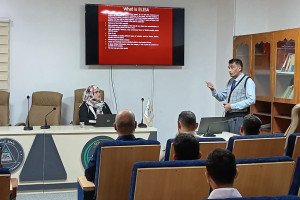
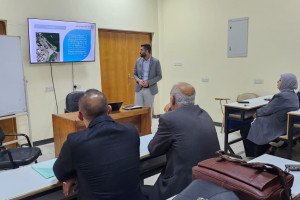
The College of Agriculture at the University of Basra organized a seminar on "The Response of Egyptian Clover Genetic Varieties to Different Seed Quantities and Estimating its Forage Value."
The seminar, presented by researcher Saif Khalil Abdul Zahra, aimed to determine the effect of different Egyptian clover genetic variations on varying seed quantities and to assess its forage value. The study also suggested cultivating the Sumer variety, as it yielded the highest green and dry forage, and planting Egyptian clover with a seed quantity of 45 kg/ha. It further recommended expanding the cultivation of the Masqawi and Sumer varieties, utilizing other factors such as NPK fertilizer, and planting the Hamdani variety in light sandy soils, as it is a spreading and dense variety suitable for grazing and mulching.
Media and Government Communication Division / College of Agriculture
Important News
viewed most