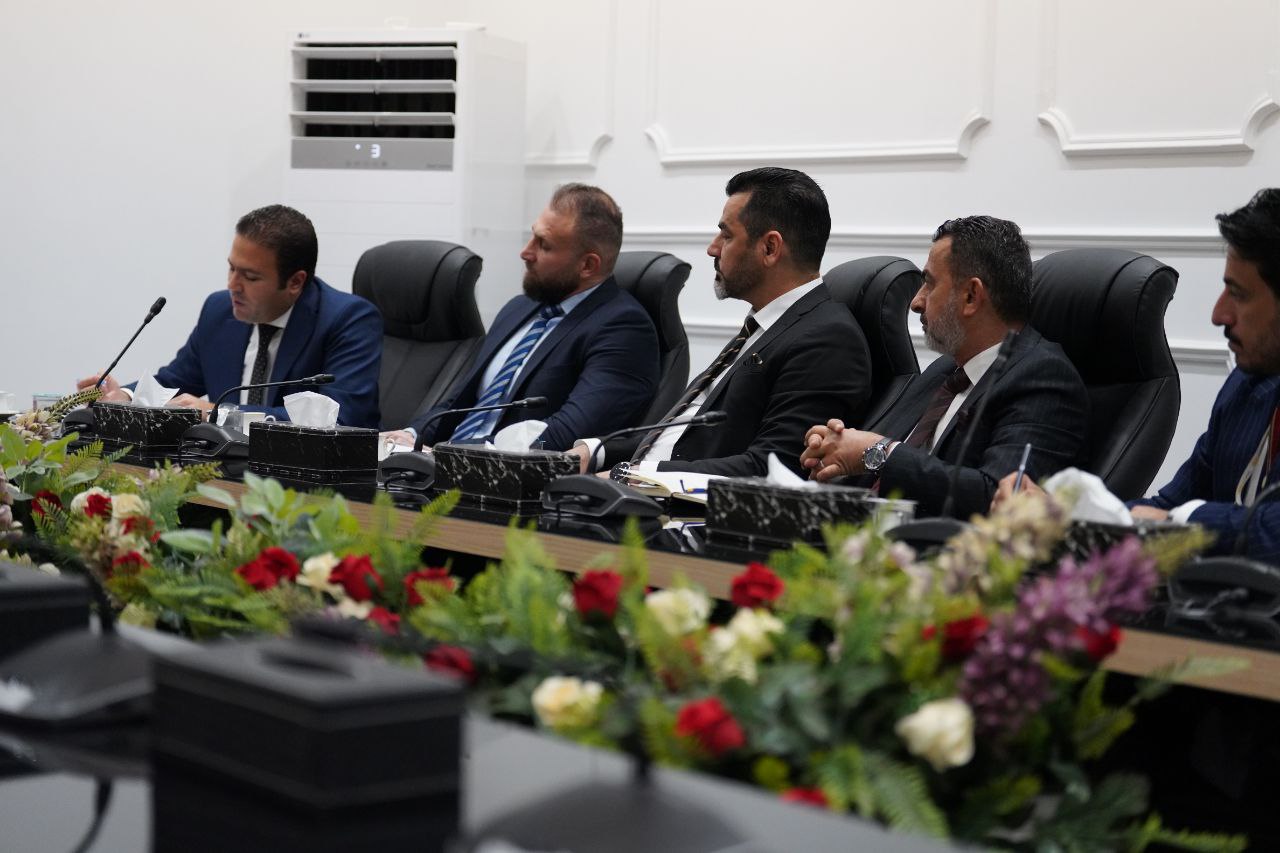
The Dean of the College of Agriculture, Professor Dr. Sarmad Ghazi Mohammed Al-Shawi, accompanied by the Director of the Consulting Office, Professor Dr. Mohsen Abdul-Hay Dashar, and in the presence of representatives from Eni, held an official meeting with the First Deputy Governor of Basra, Engineer Zaid Al-Imara, and the Director of Planning, Mr. Walaa, to discuss prospects for joint cooperation in implementing strategic agricultural projects aimed at mitigating the effects of climate change in the governorate.
During the meeting, the environmental challenges facing the agricultural sector in Basra were discussed, most notably rising temperatures, declining water levels, and increasing soil and water salinity. These phenomena are directly linked to climate change and its regional impacts, which Intergovernmental Panel on Climate Change reports have confirmed are clearly affecting agricultural systems in arid and semi-arid regions, particularly in the Middle East.
The Dean of the College of Agriculture reviewed the college's scientific and technical capabilities, including its specialized laboratories, field research stations, and training programs for farmers. He emphasized the college's readiness to provide soil and water analysis services, develop fertility maps, and offer precise scientific recommendations for irrigation and fertilization management, as well as for selecting varieties suitable for local conditions, based on the principles of climate-smart agriculture supported by the Food and Agriculture Organization (FAO).
The role of the College of Agriculture's consulting office in preparing technical studies and developing integrated management plans for agricultural areas in Umm Qasr, Zubair, and Safwan was also highlighted. These plans include salinity assessment, improving water use efficiency, and adopting modern technologies such as advanced irrigation systems and the use of salt- and heat-tolerant crops—strategies recommended by United Nations Environment Programme (UNEP) reports to enhance the resilience of rural communities to climate change.
The participants emphasized the importance of building a tripartite partnership between the local government, the academic sector, and the private sector, represented by Eni, to ensure the provision of the necessary technical and financial support for project implementation. This will contribute to reducing the economic burdens on farmers, enhancing sustainable livelihoods, and achieving resilient agricultural development capable of withstanding future climate risks.
This meeting comes within the framework of Basra Governorate's approach to adopting practical, scientific solutions based on research and application, and to activating the role of academic institutions in serving the community, in line with the global Sustainable Development Goals adopted by the United Nations, particularly Goal 13 on climate action and Goal 2 on ending hunger and promoting food security.
Media and Government Communication Division / College of Agriculture
Important News


viewed most