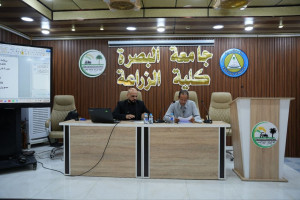
A doctoral dissertation at the College of Agriculture, University of Basra, investigated "The Response of Newly Approved Wheat Varieties to Planting Dates and Nitrogen Fertilization and Their Economic Feasibility."
The dissertation, presented by researcher Aseel Nadhim Abdulwahid Al-Abouda, aimed to evaluate the performance of two newly approved varieties and compare them with an existing approved variety in the region. It sought to determine the optimal planting date and nitrogen fertilizer level for achieving the highest quantitative and qualitative yields, as well as the most economically viable production level.
The results showed that the Al-Shaymaa variety outperformed the Ebaa-99 variety in most growth and yield characteristics. Early planting (November 1st) resulted in the best grain production compared to late planting (December 1st). The fertilizer level of 120 kg ha⁻¹ yielded the highest grain yield, net total income, return on investment, and production profitability. Meanwhile, the fertilization level of 240 kg ha⁻¹ resulted in the highest protein content in the grains.
The study recommended adopting this combination and conducting extensive studies on the Shaima variety in the southern region of Iraq.
Media and Government Communication Division / College of Agriculture
Important News


viewed most