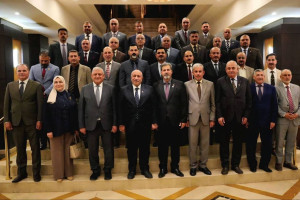
The College of Agriculture at the University of Basra reviewed a master's thesis on "Predicting Power and Fuel Losses of Two-Wheel and Four-Wheel Drive Tractors Using Artificial Neural Networks and the Levenberg-Marquardt Algorithm."
The thesis, presented by researcher Banban Abdul-Hakim, aimed to develop predictive models using artificial neural networks and polynomial regression models to estimate tractor performance variables (traction force, slip ratio, various types of power loss, and various types of fuel consumption) under different operating conditions. These conditions included four tillage depths (10, 15, 20, and 25 cm), three forward speeds, three engine speeds (1250, 1500, and 1750 rpm), and two drive types (two-wheel and four-wheel drive). The experiments were conducted in silty clay soil using a three-blade moldboard plow in a completely randomized block design with 216 experimental units.
The study indicated that tillage depth was the most influential factor, as increasing it from 10 to 25 cm led to a 65% increase in traction power, a 185.7% increase in slippage, and a 340% increase in slippage fuel consumption. Forward speed came in second place, as increasing it resulted in a 325% increase in total power loss, while the effect of engine speed was relatively less pronounced. Four-wheel drive was superior in reducing slippage and slippage power loss, while two-wheel drive was superior in reducing traction fuel consumption.
Media and Government Communication Division / College of Agriculture
Important News
viewed most